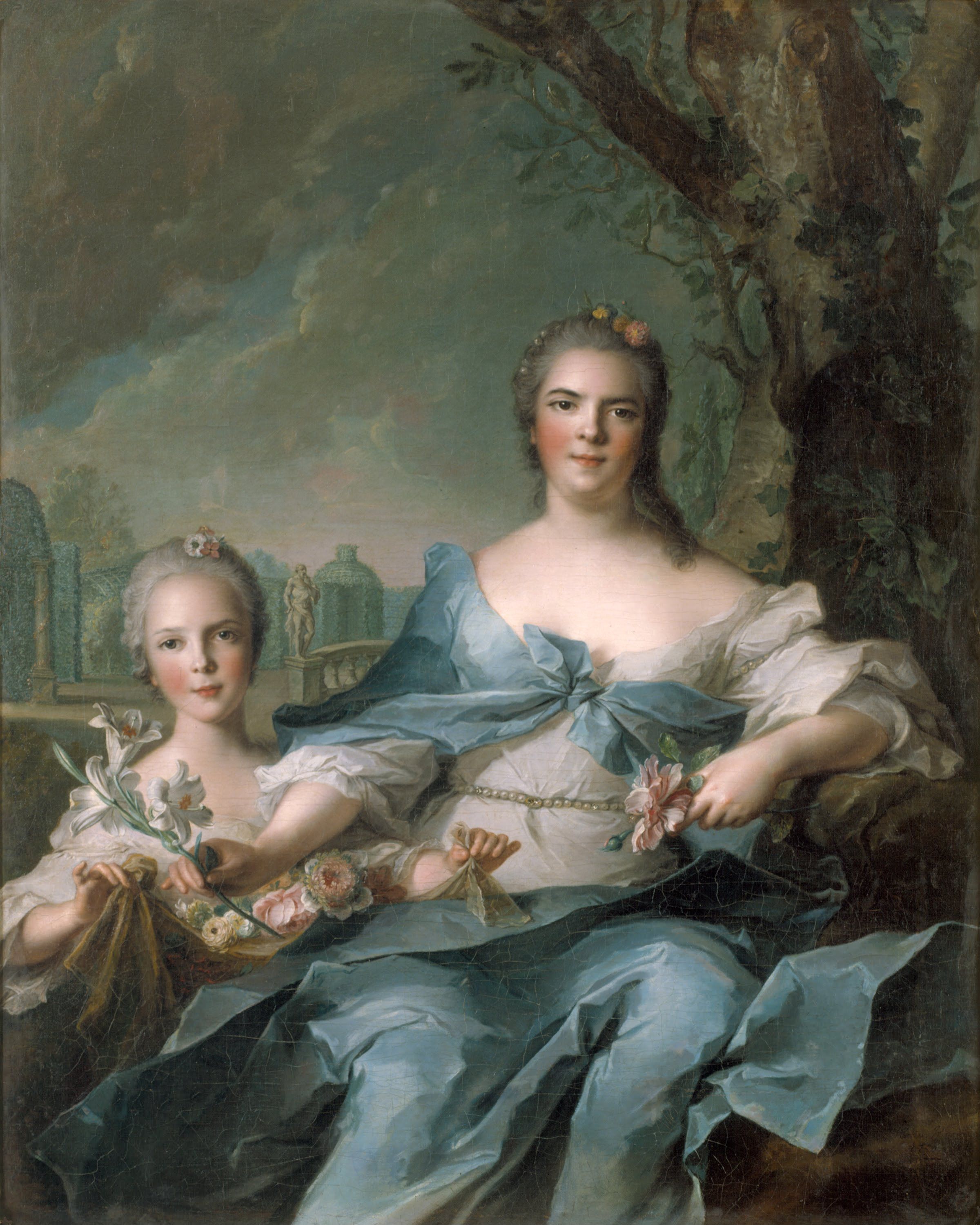
Marie Adélaïde de France, Daughter of France was the was the fourth daughter and sixth child of King Louis XV of France and his Queen consort, Maria Leszczyńska. As the daughter of the king, she was a Fille de France. She was referred to as Madame Adélaïde from 1737 to 1755 and from 1759 to her death, and simply as Madame from 1755 to 1759.
was the was the fourth daughter and sixth child of King Louis XV of France and his Queen consort, Maria Leszczyńska. As the daughter of the king, she was a Fille de France. She was referred to as Madame Adélaïde from 1737 to 1755 and from 1759 to her death, and simply as Madame from 1755 to 1759.Originally known as Madame Quatrième ("Madame the Fourth"), until the death of her older sister Louise Marie in 1733, she became Madame Troisième, ("Madame the Third"). Adélaïde also possessed the Duchy of Louvois with her sister Madame Sophie from 1777, and which had been created for them by their nephew Louis XVI, in their own right.
She outlived both of her parents and all nine of her siblings. Adélaïde, as well as her brother and sisters, attempted without success to prevent their father's liaison with Madame de Pompadour, which began in 1750.
She was deeply affected by the death of her sister Henriette at the age of twenty-five in 1752, and by the death of her brother, the Dauphin, in 1765. She became the head of the group of the three unmarried, younger sisters who survived into adulthood, the others being Madame Victoire and Madame Sophie. They all found solace in music.
Adélaïde despised her father's last maîtresse-en-titre, Madame du Barry. When the fourteen-year old Marie-Antoinette became Dauphine in 1770, Adélaïde tried to win her support against Mme du Barry, but the empress Maria Theresa opposed it. This was a factor which would cause Adélaide to bear subsequent malice toward Marie Antoinette and to become one of the most vicious rumour-mongers at Versailles.
After the dauphin's death in 1765, followed in 1767 by that of his second wife, Marie-Josèphe, Adélaïde took custody of the late dauphine's papers, with instructions concerning their son, Louis Auguste, should he become king. The papers were opened on 12 May 1774, after the death of Louis XV, who was succeeded by his grandson Louis Auguste as Louis XVI. Three distinguished names were suggested for the position of Prime Minister (Premier Ministre), that of Jean-Frédéric Phélypeaux, comte de Maurepas, Emmanuel-Armand de Richelieu, duc d'Aiguillon, and Jean-Baptiste de Machault d'Arnouville.
She outlived both of her parents and all nine of her siblings.
 Adélaïde, as well as her brother and sisters, attempted without success to prevent their father's liaison with Madame de Pompadour, which began in 1750.
She was deeply affected by the death of her sister Henriette at the age of twenty-five in 1752, and by the death of her brother, the Dauphin, in 1765. She became the head of the group of the three unmarried, younger sisters who survived into adulthood, the others being Madame Victoire and Madame Sophie. They all found solace in music.
Adélaïde despised her father's last maîtresse-en-titre, Madame du Barry. When the fourteen-year old Marie-Antoinette became Dauphine in 1770, Adélaïde tried to win her support against Mme du Barry, but the empress Maria Theresa opposed it. This was a factor which would cause Adélaide to bear subsequent malice toward Marie Antoinette and to become one of the most vicious rumour-mongers at Versailles.
After the dauphin's death in 1765, followed in 1767 by that of his second wife, Marie-Josèphe, Adélaïde took custody of the late dauphine's papers, with instructions concerning their son, Louis Auguste, should he become king. The papers were opened on 12 May 1774, after the death of Louis XV, who was succeeded by his grandson Louis Auguste as Louis XVI. Three distinguished names were suggested for the position of Prime Minister (Premier Ministre), that of Jean-Frédéric Phélypeaux, comte de Maurepas, Emmanuel-Armand de Richelieu, duc d'Aiguillon, and Jean-Baptiste de Machault d'Arnouville.
Madame Adélaïde left Versailles with Madame Victoire on 6 October 1789 with the rest of the Royal Family, on 6 October 1789, the day following the Parisian women's march to Versailles and they took up residence at the Château de Bellevue.
Revolutionary laws against the Catholic Church caused them to leave France for Italy on 20 February 1791. On their way, they were arrested and detained for several days at Arnay-le-Duc before they were allowed to continue their journey. They visited their niece Clotilde, sister of Louis XVI, in Turin, and arrived in Rome on 16 April 1791. As a result of the increasing influence of Revolutionary France, they traveled farther afield, moving to Naples in 1796, where Marie Antoine's sister, Marie Caroline, was queen.
They moved to Corfu in 1799, and finally settled in Trieste, where Victoire died of breast cancer. Adélaïde died one year later. Their bodies were returned to France by Louis XVIII at the time of the Bourbon Restoration, and buried at the Basilica of Saint-Denis.
Among her nephews were the kings of France Louis XVI, Louis XVIII, and Charles X, and Ferdinand, Duke of Parma. She had as nieces Madame Élisabeth, Clotilde, Queen Consort of Sardinia, and Queen Maria Luisa of Spain.
Revolutionary laws against the Catholic Church caused them to leave France for Italy on 20 February 1791. On their way, they were arrested and detained for several days at Arnay-le-Duc before they were allowed to continue their journey. They visited their niece Clotilde, sister of Louis XVI, in Turin, and arrived in Rome on 16 April 1791. As a result of the increasing influence of Revolutionary France, they traveled farther afield, moving to Naples in 1796, where Marie Antoine's sister, Marie Caroline, was queen.
They moved to Corfu in 1799, and finally settled in Trieste, where Victoire died of breast cancer. Adélaïde died one year later. Their bodies were returned to France by Louis XVIII at the time of the Bourbon Restoration, and buried at the Basilica of Saint-Denis.
Among her nephews were the kings of France Louis XVI, Louis XVIII, and Charles X, and Ferdinand, Duke of Parma. She had as nieces Madame Élisabeth, Clotilde, Queen Consort of Sardinia, and Queen Maria Luisa of Spain.


 On 14 May 1771, Louis Stanislas married Princess Marie Josephine Louise of Savoy, the daughter of the Duke of Sardinia, future king Victor Amadeus III of Sardinia. The new comtesse de Provence was considered to be ugly. She never brushed her teeth, plucked her eyebrows, or used any perfumes. The comtesse was pregnant two times; one time in 1774, and one time in 1781. but both pregnancies ended in miscarriages. The marrige was childless.